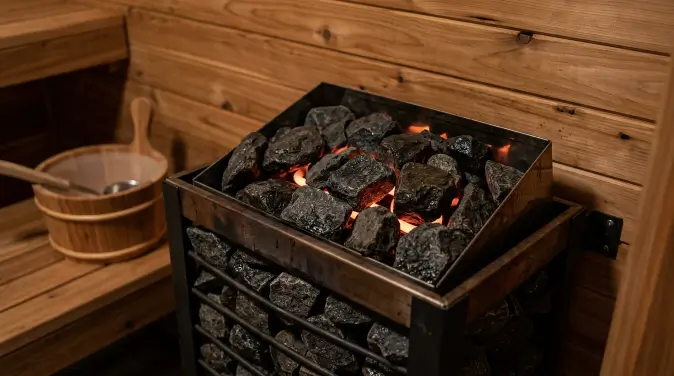
Most freestanding sauna heaters rated above about 3 kW need a dedicated 240V circuit, usually run on a 30 to 50 amp double-pole breaker with 8 or 6 gauge wire depending on the heater’s draw. Smaller heaters at or under roughly 1.5 to 2 kW can sometimes run on a standard 120V, 20 amp household outlet, though they heat more slowly and only suit a small room. On a tight budget, the deciding factor is almost always the room’s cubic footage, not personal preference, because the heater has to match the space to hold temperature through a full session.
How Do You Know If a Heater Needs 240V?
The general sizing rule is about 1 kW of heater output for every 45 to 50 cubic feet of well-insulated space. A small two-person cabin near 100 to 150 cubic feet can sometimes get by on a 1.5 to 2 kW unit, which is the range where a 120V circuit is still plausible. Once a room climbs past roughly 150 cubic feet, or has a glass door or wall pulling heat out faster than solid wood, the math pushes past 3 kW almost every time, and above that threshold 240V stops being optional. Checking the heater’s nameplate amperage before buying anything else saves a wasted trip to the panel later.
Sizing the Breaker, Wire, and Panel Space
A 240V heater’s spec sheet lists a required breaker size and minimum wire gauge, and neither should be treated as a suggestion. Most home units in the 6 to 9 kW range call for a 40 or 50 amp double-pole breaker on 8 or 6 gauge copper, run as its own circuit with no other loads sharing it. Panels that are already full, common in older homes with a 100 amp service, sometimes need a sub-panel or a load calculation before a new 50 amp circuit can be added safely, a detail worth confirming with an electrician before ordering a heater, not after.
Can a Small Heater Really Run on a Regular Outlet?
Yes, within limits. Heaters built for 120V, generally topping out near 1.5 to 2 kW, plug into a standard 20 amp outlet without any panel work, which is why they show up so often in budget one-person cabin kits. The tradeoff is real: a 120V unit takes longer to reach temperature and struggles in anything larger than a small closet-sized room, so it is not a workaround for undersizing a bigger space, only a legitimate option for a genuinely small one.
Budgeting a 240V Wiring Job Without Overspending
The single biggest cost variable is distance from the electrical panel to the sauna, since running conduit or cable through finished walls, a garage, or across a yard to an outbuilding adds labor fast. A heater near the panel, like a basement corner sauna close to the service entrance, is a much smaller job than a backyard cabin thirty feet from the house. Comparing heater listings side by side, including what sweatdecks.com carries across kW ratings, makes it easier to match a unit’s rated amperage to the simplest possible circuit run before committing to a bigger, more expensive panel upgrade. Getting two or three electrician quotes for the same scope of work is worth the extra week it takes, since bids for what sounds like an identical job can vary by a few hundred dollars depending on how a contractor prices panel access and permit paperwork.
What About GFCI Protection and Wet-Location Wiring?
A sauna is a damp, high-heat environment, and most electrical codes treat the circuit feeding the heater differently from a dry-room outlet because of that. Wire insulation rated for higher temperatures, weatherproof or high-heat-rated fixtures for any lighting inside the room, and, depending on local code, GFCI protection on the circuit are common requirements that a budget wiring plan sometimes skips to save a small amount on materials. None of these add much to the total bill compared with the labor cost of the run itself, so cutting them is a poor tradeoff against the risk of moisture reaching a standard fixture never meant for a wet, hot room.
See also: Elevating Visual Storytelling for Businesses
Permits and Inspection Are Not Optional Corners to Cut
A new 240V circuit for a wet-adjacent appliance is exactly the kind of work most jurisdictions require a permit and inspection for, and skipping it to save a fee is a poor trade against the fire risk of an undersized wire run hidden inside a wall. An inspector checking a new circuit also confirms the breaker matches the wire gauge and that the heater sits on its own dedicated line, which catches the two most common budget-wiring mistakes before they become a hazard nobody notices until something overheats. It is also worth asking the electrician to label the new breaker clearly, since a mislabeled panel is a small annoyance that turns into a real problem the day someone needs to shut the circuit off quickly.
What This Means for a Beginner on a Tight Budget
The cheapest path to a working sauna heater is rarely the cheapest heater on the shelf. It is the heater that matches the room’s actual volume and sits close enough to the existing panel that the circuit run stays simple. A slightly pricier unit that avoids a sub-panel upgrade, or a room location chosen partly for its proximity to existing wiring, often beats a bargain heater that ends up needing a much larger electrical project to actually run.
Frequently Asked Questions
Does every sauna heater need 240V?
No. Heaters at or under about 1.5 to 2 kW are typically built for a standard 120V, 20 amp outlet, but anything larger, which covers most rooms bigger than a small one-person cabin, needs a dedicated 240V circuit.
What breaker size does a typical 240V sauna heater need?
Most home heaters in the 6 to 9 kW range call for a 40 or 50 amp double-pole breaker on 8 or 6 gauge copper wire, but the heater’s own spec sheet is the final word since ratings vary by model.
Can I plug a sauna heater into an existing outlet?
Only if it is a small 120V unit rated for a standard 20 amp circuit. Any 240V heater needs its own new circuit run from the panel, not an adapter into an existing outlet.
Is a permit really necessary for a sauna heater circuit?
In most areas, yes. A dedicated high-amperage circuit near a wet environment is a standard trigger for permit and inspection requirements, and skipping it risks both safety and any insurance claim tied to a fire later.
How much does wiring a 240V sauna heater typically cost?
It depends heavily on distance from the panel, but a straightforward run to a nearby room is usually a smaller job than routing power to a detached backyard cabin, which can add substantially to the labor cost.
References
- Cardiovascular and Other Health Benefits of Sauna Bathing: A Review of the Evidence, Mayo Clinic Proceedings, 2018
- Benefits and risks of sauna bathing, The American Journal of Medicine, 2001
- Effects of heat and cold on health, with special reference to Finnish sauna bathing, American Journal of Physiology, 2018
By Marcus Whitfield